
At Easington CE Primary school, we adapt the Kapow Scheme of work to inspire our children to be innovative and creative thinkers who have an appreciation for the product design cycle through creation and evaluation. We want our children to develop the confidence to take risks, through drafting design concepts, modelling, and testing and to be reflective learners who evaluate their work and the work of others. Through our curriculum, we aim to build an awareness of the impact of design and technology on our lives and encourage pupils to become resourceful, enterprising citizens who will have the skills to contribute to future design advancements in the future. Our Design and technology scheme of work enables pupils to meet the end of key stage attainment targets in the National curriculum and the aims also align with those in the National curriculum. EYFS (Reception) units provide opportunities for our children to work towards the Development matters statements and the Early Learning Goals.
Implementation
The Design and technology National curriculum outlines the three main stages of the design process: design, make and evaluate. Each stage of the design process is underpinned by technical knowledge which encompasses the contextual, historical, and technical understanding required for each strand. The National curriculum organises the Design and technology attainment targets under four subheadings: Design, Make, Evaluate, and Technical knowledge. We have taken these subheadings to be our Kapow Primary strands:
● Design ● Make ● Evaluate ● Technical knowledge
Cooking and nutrition are given a particular focus in the National Curriculum, and we have made this one of our six key areas that pupils revisit throughout their time in primary school:
● Cooking and nutrition ● Mechanisms/ Mechanical systems ● Structures ● Textiles ● Electrical systems (KS2 only) ● Digital world (KS2 only)
Timetable
Design and Technology is taught differently across school based on teacher professional judgement, the nature of individual cohorts and the availability of different resources to deliver each unit. In some classes, Design and Technology is taught on a weekly basis throughout a half-term (each half-term alternates with Art and Design), whilst in other classes the subject is blocked and taught over the course of a week within a half-term.
Chartwells Beyond the Kitchen
We provide workshops from Chartwells to enrich our DT curriculum. These occur on a termly basis and focus on five key themes which include:
The workshops the children access throughout the year include:
Through our DT curriculum, pupils respond to design briefs and scenarios that require consideration of the needs of others, developing their skills in the six key areas. Each of our key areas follows the design process (design, make and evaluate) and has a particular theme and focus from the technical knowledge or cooking and nutrition section of the curriculum. Our DT curriculum (based on Kapow) is a spiral curriculum, with key areas revisited again and again with increasing complexity, allowing pupils to revisit and build on their previous learning.
Knowledge organisers for each unit support pupils in building a foundation of factual knowledge by encouraging recall of key facts and vocabulary. Strong subject knowledge is vital for staff to be able to deliver a highly effective and robust Design and technology curriculum.
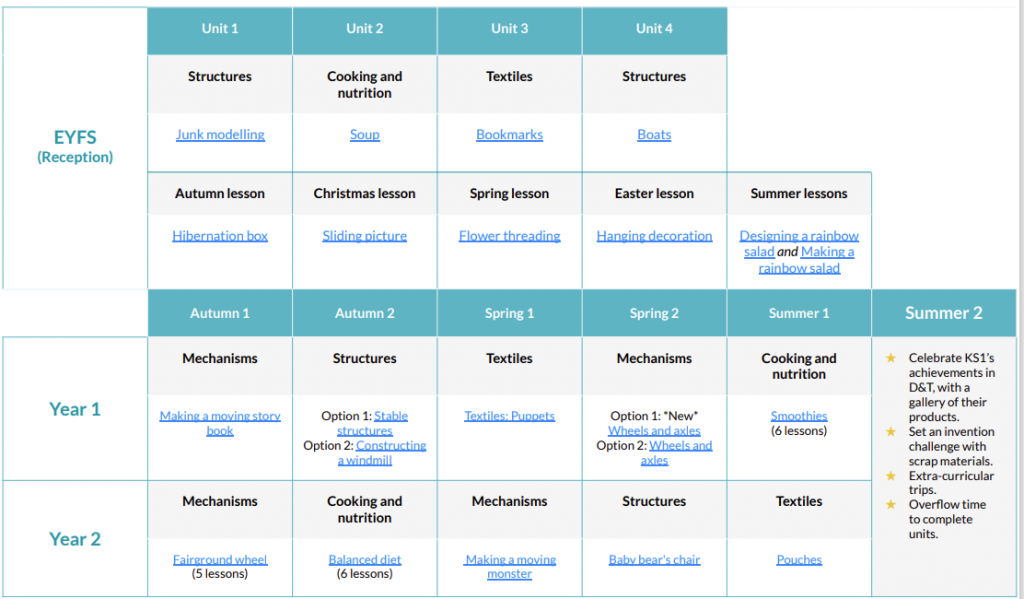
Long term Plan example (units can and do change in terms of when they are taught throughout the year linked to different events in the school and national calendar).

Through our DT Curriculum the expected impact is that our children will: